
Few sci fi books have been as popular lately as Kaliane Bradley’s novel, The Ministry of Time. It’s a beautiful work, but as I’m about to show, it has its flaws. And no, they are not small ones.
I’m aware of a certain controversy surrounding this book. When the BBC announced it wanted to turn the novel into a miniseries, it was discovered that the premise bears a striking similarity to the Spanish TV series, “El Ministerio del Tiempo.” This led to accusations of plagiarism against Bradley. But I will overlook this crisis and instead evaluate the book on its own merit. Or rather, the lack thereof.
A Bridge to…Nowhere?
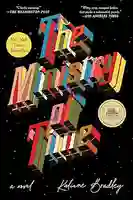
The story revolves around one Commander Graham Gore, an officer who was part of Sir John Franklin’s ill-fated expedition to the Arctic. Gore is plucked from the year 1847 by the 21st-century Ministry of Time. Such people, designated “expats,” are assigned a “bridge” who will facilitate the person’s acclimation into modern-day life. The bridge hosts the expat in their home, much as one would take in a foster child. Gore’s “bridge,” is the book’s narrator, who never gets named. All we know about her is that she’s modern, and the daughter of a British man and a Cambodian immigrant. As Bridge (we will name her “Bridge” for brevity) helps Gore get situated, the story becomes a rather predictable “fish out of water” plot, with the old officer’s old-fashioned notions coming constantly into conflict with the realities of 21st century London, England. As Gore gradually adjusts, dropping his old-fashioned ways one by one (with the exception of his rather strong addiction to tobacco), a romance develops between Bridge and himself.
The outdated notions of Gore are fun. Bridge’s explanations to him are witty. The banter is playful. And all of this is rollicking good fun. But it wasn’t long into this joyous part in the book that I, the reader, kept wondering, “What the #%%^* is the point?!” The reason for Gore’s transmutation into the 21st century seems to be, “For the hell of it.” The overall purpose of The Ministry of Time seems to be protecting the timeline, and oh, by the way, also preventing future climate catastrophe. But how does plucking people out of the past accomplish this, exactly? The novel does not say.
Spoiled Romance
Now, if you happen to be a reader of romcoms, you may not care about such nuanced details which sci fi readers care greatly about. The romance and its aftermath keep you riveted on the characters, leaving the story details unquestioned. But if you are someone who cares deeply about sci fi as a genre, what happens next is unforgiveable.
As the plot deepens, it is revealed that Bridge’s older self has come back from the future to spy on her, masquerading as one of the M.O.T. officials. That’s bad enough, as any sci fi nut always knows that going back in time to visit your past self is a VERY bad idea. But then, this future-Bridge reveals that she was the one who sent the time technology back in time, allowing the Ministry of Time to be created in the first place when the British government found it and, predictably, purloined it.

Let me say that again: The time machine gets sent back in time to invent the time machine. Meaning…
…the time machine has no inventor!
And the entire story gets sucked down a plot hole so huge it would have done Dr. Hans Reinhardt proud.
Beautiful but Impossible
Again, the love story? Beautiful. The fish-out-of-water aspect? Pure fun. But the premise makes these impossible. And so, in the end, the plot structure is built upon nothing but air.
I give Bradley a measure of initial credit. The romcom is such a cute card game that most people didn’t notice the dealer cheating an ace onto the table. But she did, and for me, that’s a deal-breaker.
The book’s Goodreads Readers’ Choice Award? Scandalous. It’s Hugo finalist nomination? An absolute travesty. Barack Obama’s Summer Reading List? Well, as much as I love Obama, he’s not really known for his sci fi recommendations now, is he?
Again, if you’re the romcom sort, you might not care. But I’m the sci fi sort, and so I care a great deal.
I give this book an A+ on romance and readability.
But in terms of plausibility, or science fiction integrity, it gets an F.

Eric J. Hildeman a writer from Milwaukee who likes to ambush an unsuspecting public with thought-provoking ideas. When not writing, he balances books as an accountant – back straight, eyes forward, head level. He has previously been published in the anthologies “Zombie Jesus and Other True Stories” (Dark Moon Books, 2012), “These Vampires Still Don’t Sparkle” (Sky Warrior Books, 2014), the inaugural issue of Bast10n Magazine (2014), and he recently self-published his first fix-up novel, “The Scotty!” (2024). He is founder of the Milwaukee Science Fiction & Fantasy League, and host of its affiliated blog and podcast, “Starship Fonzie.”
I’m unlikely to go back and re-read the book to refresh my memory, but I remember it differently. IIRC, someone invented time travel tech in the future, then opened a door to the 21st century. Someone in the 21st century looked through the door into the future, saw the time machine unattended, and pulled it into the 21st century. They’re two different timelines. In one, time travel is invented. In another, it’s technology brought from the future. That doesn’t seem paradoxical to me. But I could be mistaken, either on the specifics of the story, or on what constitutes a paradox, or both.
Yes, that would be the older version of Bridge. But the parallel universe angle doesn’t save it. Because if Bridge pulled the TT tech back to the 21st century, creating a new parallel timeline as you say, it would essentially split a single universe into two new parallel universes, halving the matter/energy quotient in each, and both universes are destroyed as a result. And if it doesn’t, then the future has no time machine inventor, meaning the past gets to time machine FROM the future, and we’re back to square one.
(I know, temporal mechanics is a b*tch.)
It’s important to know the rules of the genre. It’s just as important to know when to break them. Any author intending to write contemporary science fiction would do well to study how Bradley used the timeline trope to complement and underscore the improbable nature of the protagonist’s romance with Gore. I’m sorry that you found this so implausible that it ruined your reading experience.
Great review! And you nailed my main point about it not having a point. There was the questionable science that was barely questioned, and a whole lot of porous plot holes, but I realized early on, as you did, that it was a romance, not a science fiction book. The speculative element was a device to have a man out of time meet a woman alienated from her own racial and cultural identity. I know it will find an audience there and it was above the hack genre romances for sure. Still, I find the man, Gore, was completely unbelievable. He was a fantasied romantic female version of a man, devoid of any real aggression (all “I just wanted to court you” stuff) and his privilege and chauvinism made charming and he instantly became progressive about everything. But the real problem was they had no problem except their own problems. I didn’t mind reading it. I would recommend it to people as a romance, but a finalist for a Hugo, no.