
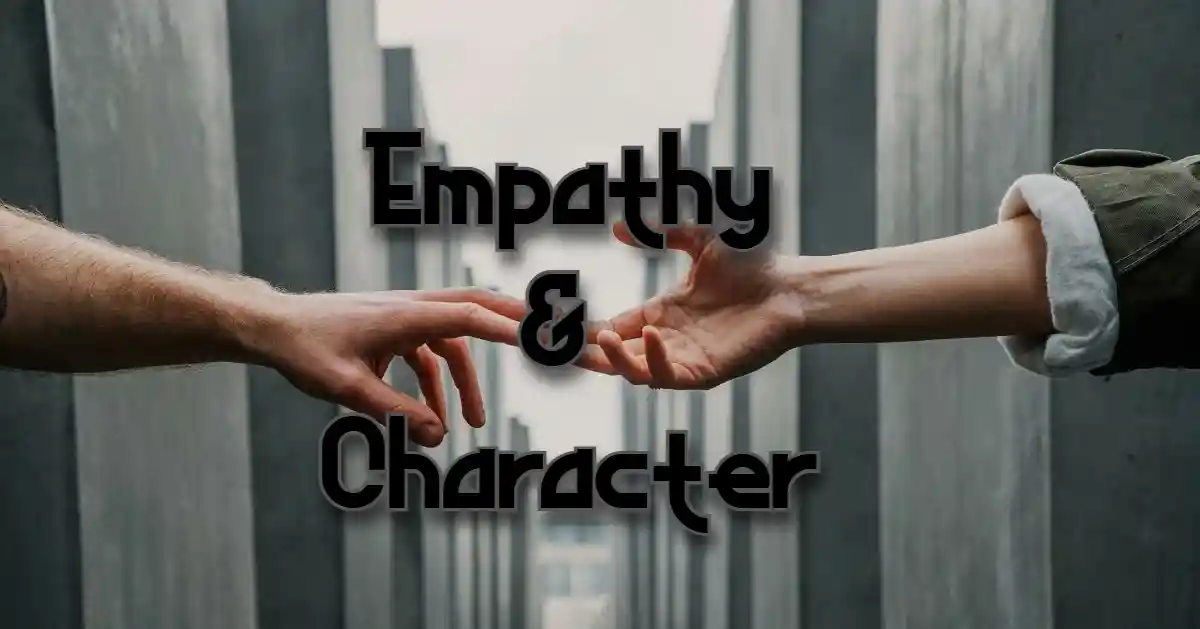
Empathy is not agreement. Empathy is “get”-ment. Empathy is a deep understanding of another person’s perspective and/or experience. But empathy does not start with understanding, it starts with a guess.
Here, we’re gonna get into how to apply empathy to a character.
On Empathy
The essential question of empathy is: What might it be like to be this person experiencing this?
Notice this question does not ask:
- What would it be like for me experiencing this?
- What is my assessment or judgment of this person experiencing this?
The answer to this essential question of empathy requires us to perspective-take. That is a step toward empathy, but not the only step. For our answer is a hypothesis, a guess which we must test. This may be more comfortable to do with our characters than with a partner or friend, but it might be helpful to know we do this all the time.
When we’re out for coffee and they’re kvetching about a job or relationship and we reply, “That sucks.” or similar, that is an expression of empathy. We are not experiencing “the suck”. But based on the tone, vibe, and other intuited signals we’re picking up from our friend or partner, we can reasonably make that guess.

The technical term for that kind of reply is a complex reflection. It is mirroring. We are mirroring back our intuited guess of the feeling/experience of the person sharing.
Notice: “That sucks.” ends with a period because this type of mirroring is, again, a guess. It is not a question. Further, it is not repeating words but getting at the underlying meaning, unstated feelings, and so on.
Sometimes our guess is correct and the person nods and continues. Sometimes our guess is wrong, and they correct us and elaborate. Either is fine as long as we work to tune our guesses (complex reflections) based on the intuited data we’re receiving. If we continue to guess “wrong”, we’re not tuned in. We are not being empathetic. In fact, we might be making an assumption vs. a hypothesis.
Assumptions are based on no data from the person or character. Hypothesis is based on intuited data coming from the person or character. Typically, our guesses are off because we’re not listening with openness and curiosity.
Another way to put it…we need to be listening from a place of acceptance, non-judgmentally. Again, we don’t have to agree with the person’s perspective, we just have to “get” their perspective. Catch it. We don’t have to feel the same way. In fact, empathy is the great equalizer because I don’t have to experience what you’ve experienced in order to empathize with you.
Consider how this may be helpful to develop a villain who makes choices we never would make (hopefully) or characters whose lived experience is entirely unique from our own.
Empathy & Character
While this might be somewhere between awkward and harrowing to try out in real life, a great way to start is with our characters. Empathizing—asking ourselves—what might it be like to be this character experiencing this situation can:
- lead to richer interiority (by direct description or action) which can lead the reader to connect more with the character and story, a deeper immersion
- help us develop more fully realized villains, antagonists, anti-heroes vs. two-dimensional placards
- manifest character arcs that are logical and connectible
So, what might it be like to be:
- a 14-year-old girl walking up to her house after school and seeing the front door of her family’s home bashed in?
- a 57-year-old man choosing to hold hostage the world by controlling the weather? What would his reasons be?
An invitation: sit down with one of your characters and don’t ask them, but ask yourself:
What might it be like to be this character with this identity (i.e. 14-year-old girl vs. a 57-year-old-man) experiencing this moment?
See what comes.
Final Thought
There’s a lot more to empathy such as context, researching, the undervalued skill of listening with acceptance, and a big something called emotional intelligence. But the word count is hitting its limit. So, let’s say this is a first step and maybe we’ll layer in more later in future posts.

Jasper Woods writes genre bending speculative fiction with a surreal tilt and a Midwestern spine. Born in western Kansas, he now haunts the Wisconsin woods. He incorporates his 30+ years working in human services into his stories, exploring the dark corners of our present from our future. Join his Substack for free and receive monthly short stories, leaning surreal and always falling under the speculative umbrella. He’s a big fan of LeGuinn, Link, Vonnegut, Butler, Atwood, Jemisin, Baldwin, Serling, Lynch, more. Married since a comet collided with Jupiter, Jasper is the proud parent of a noise maker and baker of deliciousness.
Wonderful post! Empathy is a critical part of character building and your insights here are useful and easy to understand. Thanks!