

“Once the regimes had been emptied of ideology—once power became about power alone—there was no breaking them. They had no morality. They did not become disgusted with themselves and turn away from killing. Their will did not break, no matter how many protesters they had to arrest, beat, or kill. They had no conscience, and so they were not strung by guilt. They only thing they feared was the loss of their own power.”
– Where the Axe is Buried, page 107
The Story
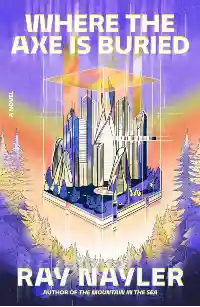
In the future, an authoritarian regime named “The Federation” dominates its citizens through repressive technological surveillance and retribution. Their president, a man who maintains his grip on power by downloading his mind into successive bodies, faces a deteriorating body and a threat to his very existence. In Western Europe, a process called “Rationalization” leads to AI Prime Ministers offering a peaceful and fair alternative to human governance, though the actions of one artificial prime minister threatens the very system that provides stability for the Western world.
With this backdrop, we follow several characters: Lilia, a scientist exiled from the Federation who makes the catastrophic mistake of returning; Palmer, Lilia’s boyfriend who seeks to find her after she disappears; Zoya, an exiled author and activist who returns to the movement; Nikolai, the President of the Federation’s personal doctor; and Nurlan, a parliamentary aid whose actions set in motion events he can barely comprehend.
Ray Nayler is a relatively new novelist and has so far penned two award winners. The Mountain in the Sea won the 2023 Locus Award and his novella, The Tusks of Extinction, won the 2025 Hugo Award. Where the Axe is Buried is his latest novel, one that blends resistance, authoritarianism, surveillance, exile, technology, and artificial intelligence with Nayler’s trademark narrative style.
Unique Multiple POV
Where the Axe is Buried is a multi-POV novel where the points of view rarely converge (similar to The Mountain in the Sea), though actions taken by one character have implications across all POVs. Chapters are headed with the name of the primary POV we are to follow, dividing the narrative both nominally and geographically across the world. It places the reader as an observer of the events and leaves them to construct the narrative whole that comprises the novel. It’s a unique way to tell the story, as many readers of multi-POV narratives expect those points of view to converge in spectacular fashion.
Though I personally love when POVs converge, I did not see Nayler’s narrative choice as a detriment to my experience. His sentences are short and sharp, the prose straightforward. He doesn’t waste time, only giving you what you need when you need it. This sparse style doesn’t lend itself to long scenic descriptions. It reads like a classic science fiction novel of old, a narrative more focused on the philosophical and social implications of the work across the entire population, the characters vehicles for presenting the argument. This doesn’t invalidate the novel; works written in this way have an extraordinary ability to provoke comparisons to the real world. They offer launching pads for the implications of technology, and what that technology can do to drive society in any number of directions.
The downside of this approach causes the characterization to suffer a bit. Each POV is distinct, and each character has clear motives and agency, though we spend little time ruminating on these qualities as the momentum of the narrative pushes them forward through the high concepts laid out.
Bleak and Chilling and Honest
The world Nayler sketches is a bleak one. One character works at an Amazon-like warehouse in London where his performance is tracked (and reprimanded) with millisecond precision. There are large seawalls that cut off access to beaches due to rising sea levels. AI slop is readily available and thoughtlessly consumed. Surveillance is so all-encompassing that people leaving flowers at a memorial are identified with facial recognition and then disappear. Automation causes skills to die out. A technology akin to a smartphone is indispensable to the world population. Artificial Intelligence (described by Nayler as “a tiger in a paper cage”) runs the world to the point of hobbling humanity. It does provide a chilling end result for a world that feels like it’s increasingly headed towards an irreversible global upheaval. Surely, we don’t all harbor the very anxiety that this book lifts up.

“What we need most is opposition. It keeps us not only honest, but human. Without it, any of us is a monster. Where there is complacency, every human power becomes monstrous. Togetherness is not agreement: it is the collective act of resisting one another.”
– Where the Axe is Buried, page 277
Resistance isn’t only necessary, it’s inevitable. Where the Axe is Buried doesn’t try to offer false hope. For that alone, the novel is worth picking up. And if you’re feeling anxious about the state of the world today, this book will be your companion.

Talha Ahmad is a writer collecting rejection slips. Despite great success in this endeavor, he has had stories published in Dark Futures, Horror Hill, Tales To Terrify, & MetaStellar, with stories forthcoming in Dirty Magick Magazine, Fiction on the Web & The Other Stories. He occasionally blogs at www.thenightbulletin.com & on Substack @talhaxahmad. He is so very tired of social media, so please voice all inquiries to the nearest house cat.
Great review 🙂
This was an intense and dark read. Thanks for the review, which was much better than what I could have written.