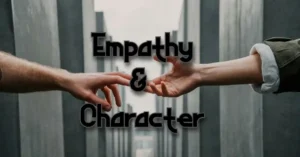
Two arms stretching across with fingers barely touching

Empathy & Character

Empathy is not agreement. Empathy is “get”-ment. Empathy is a deep understanding of another person’s perspective and/or experience. But empathy does not start with understanding, it starts with a guess. Here, we’re gonna get into how to apply empathy to a character. On Empathy The essential question of empathy is: …
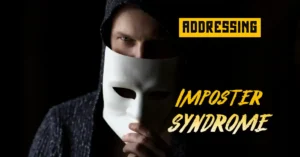
A hooded nan lowering a white mask to show half his face

Addressing Imposter Syndrome

Let’s start with how awesome it is that we have a term to name the feeling and/or belief that we are not good enough. That term: Imposter Syndrome. Here, we’re gonna get into what it is and explore some ideas on how to address it. Definition Imposter Syndrome is a …

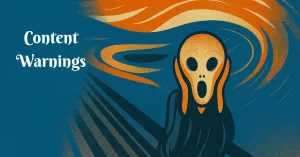
Stylized rendition of "The Scream"

Content Warnings for Speculative Fiction

What Are Content Warnings? Content warnings are brief notices that alert readers to potentially distressing material in a story. They’re not censorship, nor are they spoilers — they’re a courtesy that allows readers to make informed choices about what they wish to engage with. In speculative fiction, where themes can …

Hands holding an open book with dozens of pairs of eyes staring back

First Person POV: How Many Are Too Many “I”s?

You decide to write your story in first-person and run the text through an application such as ProWritingAid or Grammarly. Or maybe you submit it to a weekly critique session. You receive feedback that you have X number of successive “I” references in your story. You fret: “This is first-person! …

an open book with 3D mountains surrounded by charts and maps

World Building—One Person’s Approach

So, you’re writing a novel, and the world differs from the one you live in—by a little or a lot. Maybe the story is about the past or the future, or strange people, economics, or technology. There might be magic in the world, or the setting could be on Pluto. …

Cowboy writing with pen next to a campfire

Showdown, Don’t Tell: Keeping a Consistent Narrative Voice

Fiction writers have a lot of rules. “Show, don’t tell” sits near the top of the rulebook, right up there with point of view (POV), use of said tags, and eliminating adverbs. But sometimes we follow those rules straight into a literary box canyon. So take off your cowboy hat, …

Writer with pen and paper creating new worlds from his imagination

Tips for Building Worlds

Worldbuilding can be the most liberating piece of telling stories in speculative fiction, particularly in sci-fi and fantasy. Being unbeholden to the limits of our world allows your characters to have an entirely different set of environmental, cosmic, and cultural settings. It’s an opportunity for you, as the writer, to …

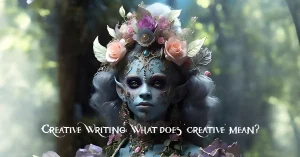
Blue fantastical female adorned with flowers and intricate jewelry

Creative Writing: What does ‘creative’ mean?

What we writers do is called ‘creative’ writing. But what is that, really? What do we have to do, to be ‘creative’ in our writing? The definition of ‘creative (adjective)’ is ‘involving original ideas in producing an artistic work.’ So, to be ‘creative’ writers, we must make original ideas. Ideas not heretofore conceived …

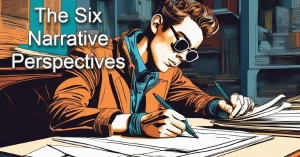
Young man with sunglasses at desk writing with strange pen.

The Six Narrative Perspectives

As a writer who has been critiqued and often critiques other authors, point-of-view (POV) is a common topic. However, talking about POV is not enough because it is intertwined with the overall narrative perspective of the work. That perspective is a mix-and-match of several concepts that should stay fairly consistent …

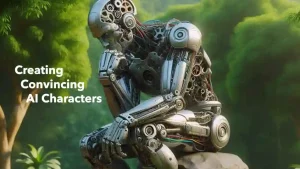
A humanoid robot posing like Rodin's The Thinker, sitting with chin resting on hand.

Creating Convincing AI Characters

You’ve got a brilliant idea for a story about an AI. Time to get writing. You sit at your desk. You boot your laptop. You dismiss those notifications about pending updates. You launch your word processor. You spend five minutes setting the font, paragraph indent, and line spacing. At last, …